Click here to return to the main index.
Day-to-day log of the 2010 search season:
8-5-09. I arrived at Stennis Space Center in the middle of the day.
8-6-09. There was a good deal of woodpecker activity in the swamp this morning. As one would expect at this time of year, the heat, humidity, and mosquitoes were a bit unpleasant. I came across a cottonmouth on the trail. Last night, I enjoyed an impressive heat lightning show over Lake Pontchartrain from the house in Slidell.
8-7-09. I spent some time this morning watching and listening along Old Hwy. 11, where there have been several sightings over the years.
8-8-09. I spent the morning in the vicinity of Tree 6, where woodpeckers and other birds were very active. On the way out there, the video camera captured the sound of a large tree falling (a low-pass filter has been applied to reduce the noise of walking through the brush).
8-10-09. While studying video obtained during a flight over the Pearl, I noticed a bayou that seems promising in terms of seclusion, large size, hardwood habitat, and proximity to the 2006 and 2008 sightings. I have never visited this bayou and have decided to call it Lost Bayou since it’s easy to overlook from the ground. I did a stakeout not far from it this morning and will explore it by kayak later on.
8-13-09. I visited Tree 8 this morning. I’m looking forward to spending some time up there but will probably wait for the weather to cool off before doing any climbing. Another tree came down nearby with an explosive crack when it broke and a resounding thud when it hit the ground. I came across a group of about six turkeys. The number of cuckoos in the Pearl seems to be higher than in previous years.
8-19-09. I spent a gorgeous morning in the swamp and had another close call with a cottonmouth. I was stepping through the branches of a fallen tree and thick undergrowth (exactly the kind of place that I most fear encountering a cottonmouth) and was fortunate to see it just in time. I did a long stakeout near Tree 6 and shorter stakeouts at other spots. The woodpeckers were active until mid morning.
8-21-09. This morning, I visited Texas Flat Rd., which runs through the Stennis buffer zone to the east of the Pearl. In recent years, there have been several late summer reports from that area, which is mainly pine forest but also contains swamps and hardwoods. The timing of these reports is consistent with the account of Herbert L. Stoddard in “Memoirs of a Naturalist.” Stoddard mentioned that ivorybills could often be found feeding on beetle larva in pines in the late summer and fall. My friend Gretchen is a wildlife rehabber and is currently caring for
baby squirrels.
8-23-09. I enjoyed a pleasantly cool morning in the swamp. The warblers, vireos, flycatchers, cuckoos, and tanagers were very active, as if preparing for migration. The trails are so thick with golden orb weavers that it’s hard to avoid their webs. After I walked into one this morning, the occupant ended up perched on my binoculars. A few days ago, I picked up another critter on the same trail. I felt something land on my hat. I pulled off my hat, and a bright orange thing flew away (probably a red wasp). It didn’t seem to be the kind of thing you want on your head.
8-25-09. I picked up a new kayak yesterday afternoon. Like the stolen kayak that it replaces, it’s a Wilderness Systems Pungo 120. The 2009 model has some nice improvements, including a nice hatch cover on the rear. The old one was solid green. This one has a camo design. While picking up the kayak, I also obtained some climbing gear.
8-26-09. This morning, I did a stakeout along this lake, which is near a stand of mature oaks that survived Katrina. I’ve been having allergy problems lately but wasn’t affected by walking through this ragweed field. It was pleasant to hear bees buzzing in the ragweed, and most of them seemed to have full
pollen baskets. Yesterday I ordered more climbing gear, including a new device for descending. Coming down from trees has caused me lots of worries since a scary incident with a descender last year. The problem was partially alleviated by an improved descender, but descents still aren’t as smooth as I would like. I’m going to get this problem resolved and replace aging gear so that climbing will be less stressful this year. Solo climbing in remote areas is bad enough without having problems with gear.
8-27-09. Gretchen and I did some practice climbing after work last night. My knee held up better than expected. When the new gear arrives, I will try different approaches for descending. I have ordered three descent devices and hope that one of them will provide the desired combination of smoothness and safety. I’ve driven a lot of miles during the past four years. The Honda Civic is up to 56,000 miles in less than two years. Many of the miles accumulated during trips back and forth between here and Virginia, but there’s also a lot of local driving. It’s 24 miles from the house in Slidell to the office at Stennis, 21 miles from the house to the parking area when entering the swamp from I-59, and 20 miles from the parking area to the office.
8-28-09. I spent some time along the main canal at Stennis, where the woodpeckers were very active this morning. There were also lots of other birds and butterflies, including
buckeyes and fritillaries. I hadn’t visited that area for a while because the road has gotten a bit rough for the Civic. I heard kents along one of the side canals in 2000, and interesting bark scaling was found in that area a few years ago. Based on Stoddard’s account from the 1890s, it seems that the
pines along the canal might be attractive to ivorybills at this time of year, especially since there’s a large swamp nearby. I found several large cavities clustered in a way that reminds me of the excavation work that appeared near Tree 6 around the time the 2008 video was obtained. Although it may have been enlarged by a mammal, the size and shape of
this cavity are interesting, as can be seen in
this comparison with 4 and 5 inch rings. The cavity near the center of this photo also appears to be fairly large.
8-30-09. I spent some time in the pines south of Stennis. I stopped at open areas and scanned in the distance with binoculars for foraging sign. I saw a gorgeous Red-headed Woodpecker.
8-31-09. I visited an area at Stennis that has a mixture of pines and hardwoods. I need to do more exploring in that kind of habitat at Stennis. Much of it is very secluded.
9-1-09. I spent the morning doing a stakeout near Lost Bayou, where woodpecker activity was high. I saw a large gator in an area where I’ve had close encounters with them in the kayak. I’ll have to be careful when paddling in to visit Lost Bayou. I saw lots of other critters, including six turkeys, two deer, a huge hog, and several rabbits.
9-2-09. Yesterday afternoon, I received a
Reverso 3
and tried it out after work. This elegantly simple device provides a sweet descent. I have ordered two other devices that should arrive this week. I came into work early this morning without stopping at the swamp because I have plans for more climbing practice this afternoon.
9-3-09. I received two new descent devices and tried them out yesterday afternoon. The Petzl I’D is very smooth, and I absolutely love the BMS six-bar rack. One aspect of the photo of the rack is confusing due to the angle. After looping over the top bar on the right, the rope continues all the way to the ground but is hidden behind the rack. The right hand (not visible in the photo) is used to apply tension to that part of the rope to control the rate of descent. It’s easy to come to a complete stop by applying sufficient tension. I will need to do more testing with a full backpack, but it appears that my problems with descending have been resolved. I will try to get up Tree 8 within the next few days.
9-4-09. Gretchen and I climbed Tree 8 this morning. The sun was shining, and the
view from up there was very nice. I used the I’D for descending, and it was nice and smooth. On the way up the tree, my backpack (which hangs below on a strap) got hung up on the sharp stub of a broken branch. When I pulled it free, it tore and was left hanging by a thread. I managed to get it before the digital camera and other contents fell about 50 feet.
9-6-09. I started rigging Tree 10, which is well located and should provide a nice view. This tree is within 500 m of a 2006 sighting and within 100 m of a 2008 sighting. It appears that it will be possible to rig this tree higher than those that are already rigged in the hardwood zone. Since pines aren’t as strong as cypresses, I’ll have to carefully select an attachment point for the rope.
9-7-09. I enjoyed a nice foggy morning in the swamp. I took a walk on one of the trails that was recently mowed and came across turkeys. After doing a stakeout in the vicinity of Tree 6, I tried to reposition the line in Tree 10 and messed it up. I’ll have to shoot it back up there and hope for a better shot.
9-8-09. I did a stakeout near Tree 10, where the woodpecker activity was high. I also made another attempt to rig Tree 10 and got the line where I wanted it on the third shot.
9-10-09. This afternoon, I visited an area in the northwestern part of Stennis that contains a mixture of pines, hardwoods, and swamp. I saw about fifty Eastern Kingbirds along an open area.
9-11-09. I finished rigging Tree 10 with Gretchen. This tree provides a better view than Tree 6, which appears near the left edge of
this photo. The six-bar rack provided a smooth descent, and I was easily able to negotiate through broken branches, like the ones in
this photo, on the way down. A Red-headed Woodpecker flew in and landed nearby right as I got to the top.
9-15-09. I did my first solo climb of Tree 8. The sun came up during the climb, and the weather was nice and sunny. It was an interesting session, with lots of woodpecker activity. Two pileateds flew by at close range, and two others flew by at a distance. A red-headed also flew by at close range. I was buzzed by a Little Blue Heron that seemed to be using Tree 8 as a landmark for navigation. The Petzl Tibloc proved to be convenient for
attaching the backpack to the rope.
This panorama gives an idea what it’s like in Tree 8. The view is better from Tree 5, but the habitat is better around Tree 8.
The video captured an interesting woodpecker flyby (the deinterlaced clip is 12 megs and plays at half speed). I found some
nice flowers on the way back. The trunk of Tree 8 is a bit narrow near the top, and gusts of wind caused it to sway quite a bit. More than two hours after the climb, I can still feel the motion, much like the feeling you get after being at sea.
9-16-09. I didn’t visit the swamp this morning, but I did take a few minutes to photograph the descent devices that I have been comparing. In February 2008, I had a scary fall using the Petzl Gri-Gri. It turns out that my 230 pounds plus the weight of a loaded backpack is way too much for that device. I then tried the Petzl STOP, which was a major improvement but still seemed to be a bit overloaded. From left to right in
this photo are the Petzl Gri-Gri, the Petzl STOP, the Petzl I’D, and the six-bar BMS Rescue Rack. The top of the photo corresponds to the upward direction. Each device is attached to the climbing harness by a carabiner, which attaches at the bottom of the device.
This photo shows the Petzl devices open and ready to receive the ropes.
This photo shows the ropes partially loaded. For each of the Petzl devices, the rope enters on the lower left, loops around, comes out the upper right, and then dangles to the ground. It is crucial to put the rope in the right way. The rope passes over a relatively small surface area inside the Gri-Gri, which provides a relatively small amount of friction. Since the rope loops over two metal pieces in the STOP and over a relatively large metal piece in the I’D, these devices provide greater friction and can therefore handle greater weights. The Petzl devices don’t operate on friction alone. When weight is applied, the metal objects rotate and clamp down on the rope. Each of these devices has a handle that can be used to gradually reduce the clamping force. When using the Gri-Gri, I often had trouble getting the clamping force to release. It seemed that the handle might break. Then it suddenly released, and I went into free fall. The same problem can occur to a lesser extent with the STOP. The I’D has an improved control system and seems to provide a smooth descent. In particular, you don’t go into free fall if the handle is pulled too far.
This photo shows all four devices with the rope fully loaded. Since the rope loops over seven bars (the top one twice), the rack provides much more friction than the other devices. This rugged and simple device doesn’t have the clamping feature, and it provides a very smooth descent. A little tension is applied with the right hand to control the speed of the descent, and it’s easy to come to a full stop. One of the advantages of the Petzl devices is that you come to a full stop when the handle is released (a slow descent may continue with the STOP). The rack and various other belay devices (such as the Figure 8) don’t have this feature, and it’s necessary to keep your hand on the rope. Some climbers attach a Prussik loop below the device as a safety feature, but I don’t find this necessary with the rack since it provides so much friction. The Gri-Gri has the disadvantage that it must be detached from the carabiner (and could be dropped) in order to attach to the rope. The only disadvantage I can see with the rack is that it’s relatively heavy and bulky. I will gladly accept that trade-off to get a smooth and worry-free descent. I’m impressed with the I’D, but it’s not as smooth as the rack, and the fact that it has an internal control mechanism doesn’t make me comfortable. Everything is external with the rack. I’m neither an expert climber nor an expert on these devices, but I find them interesting and wanted to mention my impressions of them.
9-17-09. I hiked out to near the area of a sighting last November. The woodpeckers were very active around sunrise. I discovered a large patch of pine tar on the pants that I wore during the Tree 10 climb. It would not be good to get that stuff on the rope. Considering the pine tar, the marginal view (better than Tree 6 but still not that good), and the brittleness of pines, I have decided that it would be best to stay out of that tree.
9-19-09. I spent the morning in Tree 8. It was
misty up there at first. Once again, there was a great deal of woodpecker activity. For the third climb in a row, a Red-headed Woodpecker flew by at close range. It was exciting to watch a pair of pileateds in a long flight over the treetops. I hope to see an ivorybill in that kind of flight. I saw a coyote on the way in. The mosquitoes were bad, but fortunately they didn’t follow me up the tree.
9-23-09. I took the new kayak out for its maiden voyage. Unusually high water made it possible to paddle to within 100 meters of
Lost Bayou, which I visited for the first time. It’s not far from the 2006 hot zone, and the bird in the 2008 video was flying from that direction.
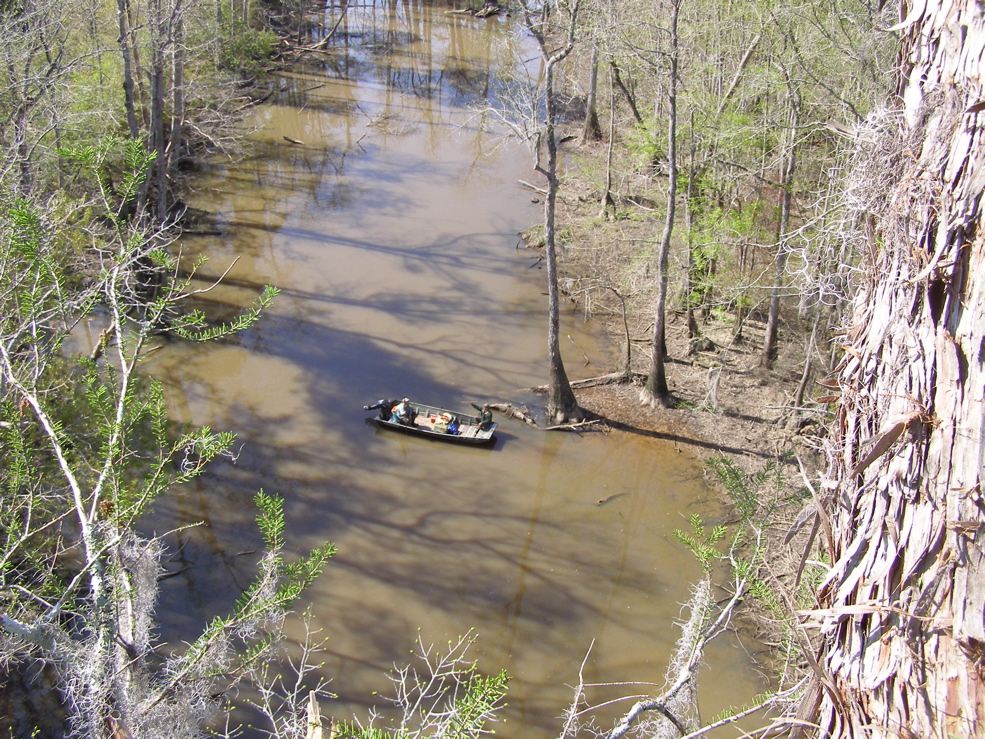
This photo shows the view in the opposite direction. It appears to get wider further down, but I only had time for a brief visit this morning.
While sitting in the kayak near Tree 6, I took this photo of Tree 10 poking up in the background. The bird in the 2008 video flew by the tupelo that juts out into the water on the right. During my first three years in the Pearl, I had more sightings of Ivory-billed Woodpeckers than Red-headed Woodpeckers, but I’ll never be able to say that again. I must have seen a hundred Red-headed Woodpeckers this morning. I came across numerous groups of them, and it was the most common woodpecker species this morning by more than an order of magnitude. The only comparable experience I have had with high woodpecker numbers was at Cape May on a good day for flickers.
9-25-09. My interest in Tree 9 has been increasing. It’s in a secluded location not far from Lost Bayou, and it provides a better view than Tree 6. The problem is that it’s hard to reach except by kayak when the water is high. This morning, I made my first attempt to establish an easy route between Tree 9 and a main trail. I tried an approach that started out with wading for a long stretch, but I ran into blackberry thickets after getting out of the water. I was fighting my way through them, but I decided to turn back when it was no longer possible to get a GPS reading. I didn’t want to fight through the thickets without knowing that I was heading toward Tree 9. Next time, I’ll try approaching from a different direction.
9-27-09. I made another attempt to find a ground route to Tree 9. It appears that the blackberry thickets and other undergrowth are impenetrable from all directions. I might have to visit that tree by kayak only. The downside of that option is that it’s hard to arrive early in the morning. I also visited Tree 6 and saw a large bird with a duck like flight speeding up the bayou just as in the 2008 video. It got my heart going for a few seconds, but it turned out to be a Wood Duck.
9-30-09. I spent a gorgeous fall morning in Tree 8. There was a nice Northern Harrier flyby just after I got to the top. I was buzzed by a White Ibis, and a Brown Thrasher cast a wary eye on me from a tree nearby. There were lots of migrants in the treetops, including several Gray Catbirds. A cooperative Red-bellied Woodpecker worked on a dead branch nearby. Red-headed and Pileated Woodpeckers were very active throughout the morning. There is frequent woodpecker activity at two impressive dead trees within 500 m, including this one, which has a huge cavity at about 50 feet (not visible in the photo). On the way back, I got a photo of a Golden Orb Weaver.
10-6-09. It was an interesting foggy morning in Tree 8. It took a while for the
sun to burn through. I took out the laser rangefinder and compass in order to determine the coordinates of two dead trees. Before putting the laser away, I determined that my feet are 87 feet above the water
in the observation position. By comparison, the pulley in Tree 6 (which is above my head) is only 82 feet above the water. I got some footage of a pair of ibises that flew by in the fog (the movie plays at half speed). I’ve been working out in the gym and losing weight. It seems to be helping because I’m now able to climb Tree 8 in 15 minutes with a loaded backpack.
10-7-09. Red-headed Woodpeckers have been very active around Tree 8 recently. Yesterday a small woodpecker, which appeared to be one of the Red-headeds, was flying by and then suddenly changed course and
flew directly over (the movie plays at half speed). It seemed to be checking me out. This still frame shows it going over. I believe Tree 10 is the large pine on the horizon a little to the left of center in this photo. Yesterday I noticed a big cypress far in the distance to the south, but the bearing isn’t quite right for Tree 5. It must be part of the big grove to the west of Tree 5.
10-8-09. As I arrived at a stakeout this morning, a large bird flushed from about 20 feet below the treetops. It had large white patches on the dorsal surfaces of the wings, and the size and behavior seemed right. I saw a
fairly large gator on the type of small bayou that I often wade across. On the way out, I saw a
nice mix of fall flowers and ran into two guys from the LDWF. They mentioned that unusual square-shaped cavities in cypresses were found in the Pearl in 2002. I wonder if they were like
this one, which was found on Tree 6 along with several similar fresh cavities in the same area around the time the 2008 video was obtained. No new cavities of that type have appeared near Tree 6 during the past 18 months despite heavy activity by the other woodpeckers in that area.
10-9-09. Frank from Louisiana is in for a visit. We hiked out to Tree 6 late in the afternoon and then went to dinner.
10-10-09. Frank and I parked along I-10 and hiked deeper into the big grove of cypresses than I had ever been. Although this secluded area is a few miles south of the hardwoods, the woodpecker activity was high throughout the day. There are many cypresses over 100 feet in the big grove, but one of the more interesting ones that we saw had the top broken off. In this photo, the top appears in the foreground and the bole appears in the background. The top landed right side up and gives the impression of a separate tree. The bole has several large cavities. We also noticed a palmetto growing in a long dead cypress.
10-11-09. There was no dry land in the area we visited yesterday, and the water level averaged about knee deep. It’s tough going under those conditions, but my knees seemed to hold up and I’m getting my stamina back after losing weight. During the hike, we saw
an unusual cypress knee,
a two-headed cypress, and lots of
big cypresses.
10-15-09. I hiked out to Tree 8, but the bayou was too deep to cross after the recent storms. I’ll have to wait a few days for the water to go down and might take the kayak out in the meantime. I saw a bobcat while driving through the north part of Stennis.
10-17-09. I did a stakeout near Lost Bayou on a cool and windy day. The birds weren’t very active, but the sapsuckers have returned. Now that the first real fall weather has arrived, it’s nice to get some relief from the mosquitoes. I made another attempt to find a ground route to Tree 9. I was making good progress fighting through the blackberry thickets but turned back when my GPS failed. After consulting the user’s guide, I reinitialized the GPS, and it seems to be working.
10-18-09. I saw another bobcat at Stennis late yesterday afternoon. Equipped with a working GPS, I spent today establishing a ground route to Tree 9. I wore a thick camo jacket to break through the blackberry thickets that I couldn’t go around. I found a good route that will make it practical to spend time in Tree 9, which isn’t as tall as I would like but is probably the best located of all the trees.
10-22-09. There is flooding in the Pearl. It’s not as bad as it was in the spring, but part of Oil Well Rd. is flooded. I did stakeouts at a few areas this morning.
10-24-09. The water is still high, but I put on the waders and hiked out to the Tree 6 area. The water got up to nearly waist deep at one point. It’s till too deep to get to Tree 8.
10-30-09. The water is going down, but there’s still a place on the way to Tree 8 with waist-deep water where there’s usually none. On the way to Tree 6, water that was waist deep last week is now below knee deep. Near the location of one of last year’s sightings, I found extensive scaling of very tight bark that was done within the past week. Some of it can be seen in
this photo.
11-1-09. I finally made it to Tree 8. The main obstacle during the flood was
this bayou, which is now only a little over waist deep. The water is still a few feet higher than normal, and I took this photo of the reflection of Tree 8 off the water at its base. Nice weather is predicted this week, and I will try to spend some time in Tree 8.
11-3-09. I heard two possible double raps and obtained two interesting video clips from Tree 8 this morning. The bird that flies toward the camera in
this clip (movie plays at full speed) has a flap style consistent with a large woodpecker, lots of white on the wings, and a persistent white spot that seems to be consistent with dorsal stripes. When inspecting other parts of the video tape, I discovered this clip (movie plays at full speed) of a bird gliding on fixed wings that have prominent white patches. I saw an ivorybill in a similar glide last year.
11-4-09. I heard two possible double raps early this morning from Tree 8 but didn’t see anything.
11-5-09. Bob from Oregon is in for a visit. I obtained this clip (movie plays at half speed) from Tree 8, while Bob dozed below after an overnight drive.
This discussion of the footage was produced later.
11-6-09. I spent another morning in Tree 8. Bob stayed up there for nine hours.
11-7-09. I’m totally exhausted after spending my fifth morning in a row in Tree 8. I’m going to take a few days off since I need rest and the hunting season just started in the Pearl.
11-8-09. There have been suggestions that the woodpecker in the video from November 5 is a red-headed, but there have also been claims that it can’t be a red-headed.
11-13-09. I made it to the top of Tree 8 just after sunrise and obtained video of a Red-headed Woodpecker in flight. Based on this footage and additional footage that was obtained by others, there now seems to be a consensus that the bird in the November 5 video is a red-headed. A pair of Wood Ducks landed on the water below without seeming to notice me.
11-14-09. Gretchen and I visited Tree 9 this morning. I have become much better at climbing since that tree was rigged. I climbed above the point where the rope is tied and found a comfortable observation point about 80 feet above the ground. Tree 9 is in a great location in terms of seclusion, habitat, and proximity to sightings, and it provides a
nice view over the surrounding trees. Tree 10 is the big pine in
this photo. I may have spotted Tree 8 far in the distance, but it’s partially hidden by another tree.
12-31-09. I closed out the year by kayaking to Trees 6 and 9 on a gorgeous spring-like afternoon. I was surprised to see a dragonfly at this time of year. It was my first visit to the swamp in more than a month and only my second kayak ride this search season. I paddled the same route as last time and once again saw lots of Red-headed Woodpeckers. The water is now high enough to access the mouth of Lost Bayou. If I can find a way around a big fallen tree just up from the mouth, that would be an interesting area to explore. The sun was setting on the way back, and I was surprised to see a Great Horned Owl deep in the swamp and not far from my first ivorybill sighting. I also saw an otter.
1-1-10. I went through yesterday’s paddle-cam footage and downloaded some pileated flight data and images showing the current and
a reflection off the bayou.
1-2-10. I took advantage of the high water and did some exploring along
this bayou, which I had previously only explored on foot. I paddled through the area where four possible double raps originated last month and made it all the way to Tree 8, which is on the left edge of
this photo. I saw this
Red-headed Woodpecker in the area where I usually see them when hiking to Tree 9. On the way back, I took
this photo that shows Tree 6 on the left and Tree 10 in the distance. Early in the day, I thought about entering Lost Bayou but couldn’t find an easy way around
this fallen tree. I will try to get into Lost Bayou soon and also look forward to repeating the route that I took today.
1-3-10. Since the arm that I broke in 2007 was a bit sore after a long day in the kayak, I decided to give it a rest and take a leisurely walk in the Honey Island swamp. The gate at the I-59 entrance is now open, but the trails are still flooded.
This photo from yesterday shows one of the trails under water. I paddled out onto this trail and didn’t recognize it at first despite having hiked it many times. Paddle-cam makes it easy to get video clips like this of encounters with birds that don’t last long enough to set down the paddles and grab a video camera.
1-6-10. I found interesting foraging sign on the same tree where I found similar foraging sign at the end of October. This scaling of tight bark is among the most interesting that I have seen. In early November, I heard four possible double raps and obtained two interesting video clips in the same area. I regularly walk past this tree and believe that the foraging occurred during two visits. Such extensive and intermittent foraging seems to be more consistent with the ivorybill than with other woodpeckers. The fact that there were two extensive foraging visits two months apart may provide insight into the fact that cameras aimed at foraging sign have yet to produce an image. It has been unusually cold this week, and parts of the trails are covered with
ice, which forms interesting patterns
as it melts and the water recedes. One of the dead trees that has been standing since Katrina recently broke apart, leaving two pieces on the ground and about half of it
still standing.
1-8-10. During a hike to Tree 9, I inspected the tree with interesting foraging sign and found that there hasn’t been any further activity. As these photos show, the water has gone way down since last week. The water in the lower photo connects to a bayou that was flooded over its banks.
1-10-10. I took a hike in the swamp to verify that the water has receded enough to wade all the way to Tree 8. Along the way, I saw a bayou with extensive ice cover, which is an unusual sight this far south. As the water continued to recede,
ice broke free from tree trunks and made
cracking sounds all up and down the bayou. The audio clip contains a periodic mechanical noise made by the camera. The cracking sounds (some near and some distant) are of the ice breaking up around tree trunks.
1-13-10. I did a stakeout near Tree 6.
1-18-10. This morning, I visited Oil Well Rd. It was a little tricky getting through in the Civic due to recent rainfall, which left the road muddy in places. The weather was beautiful and spring like.
1-19-10. It was another gorgeous morning in the swamp.
1-22-10. I did a stakeout not far from Tree 6 this morning. I’ve been seeing duck hunters lately, and that’s a bit of a concern since an ivorybill in flight can easily be mistaken for a duck. The weather continues to be gorgeous.
1-24-10. I visited the swamp after it finished raining this morning.
1-26-10. I found interesting foraging sign not far from Tree 8. It’s similar to the foraging sign that I found on and near Tree 6 around the time when the 2008 video was obtained.
1-28-10. It was very birdy in the swamp this morning. I decided to wear boots rather than waders and wasn’t able to go as far as desired since the water has come back up. I have always wanted to get a nice photo of the undersides of the wings of a flicker. I had what seemed to be a good chance this morning, but I was only able to get part of it.
2-1-10. I did a stakeout near Tree 6 this morning. On the way there, I found interesting foraging sign at two sites.
2-3-10. I visited the location at Stennis where I heard kents exactly ten years ago.
2-5-10. The swamp was beautiful this morning. The air was fresh after yesterday’s rain, and the birds were very active.
2-7-10. After spending about half of my time in Louisiana since Katrina, it’s exciting to see the Saints win the Super Bowl.
2-8-10. I tried to enter the swamp this morning, but the gate was locked due to flooding.
2-9-10. It looks like the road into the swamp will be closed for the rest of the week.
2-23-10. I did a stakeout near Tree 6 and found fresh foraging on the tree where interesting foraging of tight bark was found on October 30 and January 6. The flood waters are receding, but one of the stream crossings on the way to Tree 6 is still waist deep.
2-26-10. It was a gorgeous morning in the swamp, where the first signs of spring are starting to appear. The Northern Parulas, Yellow-throated Warblers, and Swallow-tailed Kites will be arriving any day now. I must also head north to spend some time in the Washington office, but I will be returning to Stennis permanently later in the spring.
3-1-10. I have arrived back in Washington but plan to return to Louisiana soon.
3-12-10. I have arrived back in Louisiana, but I won’t be able to visit the swamp for a few days.
3-15-10. I saw a bobcat in the swamp this morning. The Northern Parulas and Yellow-throated Warblers have arrived. I did a stake out near Tree 6.
3-17-10. It was a misty morning in the swamp. It’s starting to get green, which is appropriate for St. Patrick’s Day.
3-19-10. I did another stakeout near Tree 6. It was an exceptional spring morning.
3-22-10. On the access road south of Stennis this morning, I saw a pileated in a long distance flight about 200 feet above the ground. I’ve seen pileateds in such flights in the same area several times before. I would bet that ivorybills make similar flights, perhaps when moving between river basins.
3-24-10. It was a nice foggy morning in the swamp. The woodpeckers were very active, and I had my first Hooded Warbler and Louisiana Waterthrush of the season.
3-26-10. I did a stakeout in the vicinity of Lost Bayou this morning. The swamp is beautiful with
signs of spring everywhere. I’m getting the urge to spend time in the trees again and plan to do so soon.
3-29-10. I climbed Tree 8 and visited Tree 6, where I had my last ivorybill sighting exactly two years ago. It was the windiest tree climb I have ever done, and the top of Tree 8 was really swaying. It took about eight minutes to climb up to 87 feet, which is several times faster than when I started climbing in 2007. I had a nice view of the leaves coming out from the top of Tree 8.
The water is way down near Tree 6. Video footage of the climb is available
here.
3-30-10. Tommy Tuma and Wayne Higginbotham of the Louisiana Department of Wildlife and Fisheries visited Tree 6 with me in order to repeat the wingspan estimate of the bird in
the 2008 video. My climbing skills have improved to the point that I felt comfortable climbing a little to the side and breaking off a few small tree branches, which made it possible to obtain a
much better view than I obtained in
June 2008. The
view from up there was nice with the leaves coming out. We traveled to Tree 6 on the water and passed through the 2006 hot zone. Just before we arrived at Tree 6, a large bird flew up and landed on a tree deep in the woods. I saw a large white patch that could have been the white triangle on a perched ivorybill. Based on the way it moved and disappeared, I had the impression that it may have been the bird, but we weren’t able to relocate it.
4-1-10. I have some images from high-def video footage that was obtained earlier in the week. The first three images illustrate the single-rope climbing technique that I’ve been using in the Pearl.
In this image, my weight is borne by the gold ascender, which I’m holding with my right hand. The ascenders are designed so that they only slide upwards on the rope. They are attached to the climbing harness by Technora cord, which is only 5 mm in diameter but has a tensile rating of about 5000 pounds. In this image, I’m raising my legs and the blue ascender, which is attached to the climbing harness and has straps for my feet.
In this image, the blue ascender bears my weight as I stand up in the leg straps. I then raise the gold ascender and repeat the process until reaching the top.
This image shows me in the observation position about 75 feet above the bayou in Tree 6. This image shows me reaching out to clear a small branch out of the way in order to get a reference photo.
4-7-10. It was a beautiful morning along the bayou, where
this warbler was singing. Lots of migrants are passing through, including the first cuckoos, but I still haven’t seen a Swallow-tailed Kite this year.
4-23-10. I did a stake out in the Tree 6 area this morning. While sitting along the bayou, I kept watch in both directions out of the corners of my eyes. A bird with large bright-white patches on the wings flew across the bayou at high speed far to my left. I swung the camera in that direction but was too late. It crossed the bayou near the bank that is visible in the distance in
this image. In the same area, we caught a glimpse of an interesting bird on March 30. It was nice to finally see some Swallow-tailed Kites in the Pearl this year. Other arrivals since my last visit were Kentucky Warbler, Yellow-breasted Chat, and
Swainson’s Warbler.
4-29-10. I did my first solo climb of Tree 9, and the view from up there is very nice now that the swamp is so green. I almost got seasick from swaying each time the wind gusted. A Fish Crow was about to land in the crown of Tree 9, but it saw me at the last moment and made a sharp turn. Both kites put on nice shows nearby, including my first Mississippi Kite of the year. I heard two more Swainson’s Warblers, which seem to be more common in the Pearl than in previous springs.
4-30-10. I burned about an hour of high-def video from Tree 9 to DVD. It was relaxing to sit back last night and watch it on a big-screen TV and listen to the birds singing and other sounds. I also extracted several images from the video. A crow tried to harass a Swallow-tailed Kite but was no match for it
in the air. There were close flybys of a
Little Blue Heron,
Great Egret,
Mississippi Kite, and then
the kite again. Tree 9 only provides a partial view of
the bayou.
5-10-10. I did a stake out near Tree 6. Early in the morning, it was gorgeous and cool with lots of bird song. After it warmed up, the birds stopped singing and the flies started biting.
6-1-10. I did a stakeout near Tree 6 this morning and enjoyed the
sounds of spring. It was nice to get back out in the swamp, even though the flies and mosquitoes were biting.
6-2-10. Near Tree 6, the mud along the banks of the bayou is nearly black (almost like sooty ground after a grass fire), and this is why the dark plumage of the bird in the 2008 video is difficult to see. I’ve been aware of the color of the mud for a long time, but I never obtained a good image since the water level and light need to be right. The conditions were right yesterday, and the black mud shows up well in this image.
7-26-10. I visited the swamp for the first time since early June. I had been itching to get back out there, especially when I drive over the high bridge on I-10.
A day-to-day log of the 2011 search season is posted here.