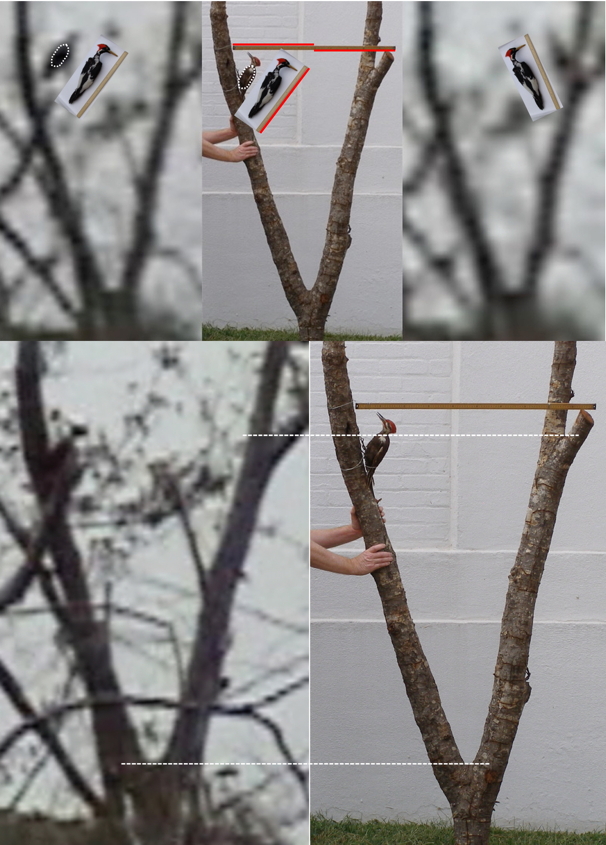
The above images are from a video that was obtained during an encounter with an Ivory-billed Woodpecker in the Pearl River in Louisiana on February 20, 2006. After the tree in which the bird was perched blew down during a hurricane in 2008, the main fork was collected
(with a permit from the Louisiana Department of Wildlife and Fisheries). The images from the video and the image with the mounted Pileated Woodpecker specimen (from the Auburn University Museum of Natural History) were scaled using features of the tree (dashed lines). As can be seen from the specimens (from the Smithsonian Institution) that appear in the inset photo, the Ivory-billed Woodpecker is larger than the Pileated Woodpecker. The bird in the video is partially hidden in the clearest image from the video, but it is clear from the other images that it is a large woodpecker, and, in fact, the size relative to the mounted Pileated Woodpecker specimen appears to be consistent with an Ivory-billed Woodpecker. Only two large woodpeckers have ever been documented north of the Rio Grande in North America, but several behaviors and characteristics of the bird in the video are consistent with an Ivory-billed Woodpecker but not a Pileated Woodpecker. The 2006 video is discussed below and in a lecture and journal articles that may be accessed in the Quick Links section at fishcrow.com.
While paddling upstream in a kayak at 7:25 that morning, I saw an Ivory-billed Woodpecker perched less than 20 meters away on the side of a
broken-off tree on the bank. It was my fifth sighting in five days in that area, where I also heard kents on two occasions (once coming simultaneously from two directions). The bird flew into the woods in the downstream
direction, and high-pitched calls immediately started coming from that direction. I had heard the same calls coming from the direction of an Ivory-billed Woodpecker in the same area two days earlier.
Several of the high-pitched calls were captured in the video. Two American Crows that seemed to be harassing the bird can also be heard in the video. The footage discussed in the
context lecture documents that I turned the kayak around just after the sighting, started drifting back downstream, and kept the camera aimed in the direction of the source of the calls. After the calls seemed to stop, I backed the kayak into an observation position against the opposite bank. More than ten minutes after the bird flushed, I detected movement at mid-level in a tree deep in the woods (128 meters distant). While unsuccessfully trying to spot the bird in binoculars, I kept the camera aimed in the direction of the movement and captured the footage discussed below. Note that the field of view was nearly centered on the location of the bird before I detected the movement and zoomed the camera. Skeptics might consider the probability of an experienced bird watcher thinking he saw an Ivory-billed Woodpecker (for the fifth time in five days), tracking its movements through more than 200 meters of dense vegetation for more than ten minutes, and then obtaining video footage of a large woodpecker that has several characteristics consistent with an Ivory-billed Woodpecker but not a Pileated Woodpecker. The 2006 video was captured in a continuous stream of 38 minutes of footage that contains no calls or drumming by a Pileated Woodpecker.
This movie (17.1 megs) shows the location where the 2006 video was obtained relative to the location where the 2008 video was obtained. Relatively bright green trees occur along the winding bayou. I was aiming the camera at a steep angle most of the time, but it pans upward around 0:06 and gives an impression of the vastness of the Pearl River basin. At 0:22, the location where the 2008 video was obtained is at the lower-left corner of the picture. At 0:30, the picture is centered on a location where I heard loud pounding and then something with loud wingbeats fly across the bayou behind me on 12-26-07. In the same area on 1-17-08, I found a large amount of interesting foraging sign. At 0:37, the camera is aimed down the stretch of bayou where the 2006 video was obtained. At 0:57, the video shows the location where I had my first Ivory-billed Woodpecker sighting two weeks before finding the 2006 hotzone.
Assessment of an expert.
The comments that follow were provided by an artist whose paintings of Ivory-billed Woodpeckers have
appeared on the covers of the leading contemporary text on this species and a leading ornithology journal.
The “long but fluffy and squared-off crest.”
The image below shows the bird perched on the right side of a branch just after I got the camera on it at about the 10:19 mark in the video. A few seconds later, it rotated behind the branch and hid. Then it
climbed a little higher and rotated back into view. The view is at an oblique angle in which the back of the bird is rotated away from the camera as illustrated in the artwork by Michael DiGiorgio. The crest and head
shape appear to be consistent with the Ivory-billed Woodpecker specimen. There appears to be a hint of the dorsal stripe on the side of the neck (this feature may not be visible on some computer screens).
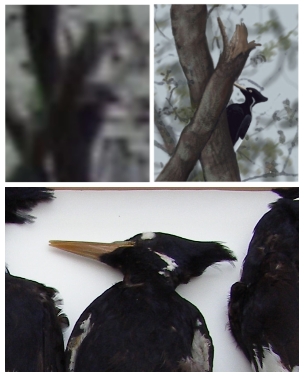
Dorsal stripe and raised crest. Since the video was obtained early on an
overcast morning, it’s difficult to see field marks
in raw images of the bird silhouetted against the sky. After adjusting the brightness, a feature consistent
with the left dorsal stripe is visible in the top left image (this feature is difficult to see on some
computer screens). The similar feature to the left of the dorsal stripe is a broken branch as illustrated
in the artwork by Michael DiGiorgio. The faint light streak across the head is a small sprig of vegetation.
It’s clear from the image on the lower left (from about one second earlier in the video) that there is no vegetation in the position where the dorsal stripe feature appears when the bird moves into view. The crest appears to be raised in the image in the lower right as illustrated in the artwork.
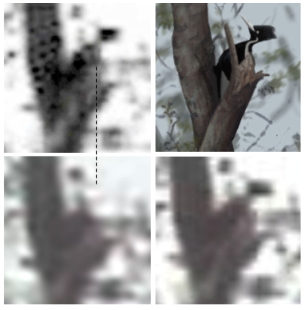
The “rared-back pose.”
The images below compare the postures of an Ivory-billed Woodpecker in a Tanner photo, a Pileated Woodpecker, and the bird in the video at the 10:27 mark in the video. Roll the cursor over the image on the right to compare the bird in the video and the Ivory-billed Woodpecker in the Tanner photo.
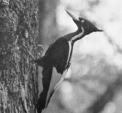
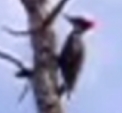
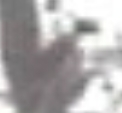
The “flapping leap” and the “ponderous and heavy flight.”
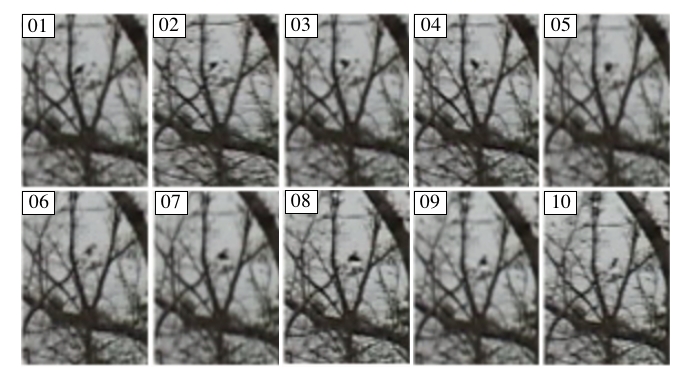
At the 10:35 mark in the video, the bird takes a
flapping leap (movie plays at half speed) across the fork.
Individual frames of the video appear below. The distance of the leap is less than one meter. A Pileated
Woodpecker would hop between those limbs almost effortlessly, but the Ivory-billed Woodpecker has a
much higher mass and lower wing area, and it usually flaps during short flights from limb to limb according
to Tanner. At the 11:30 mark in the video, the bird takes off with
deep and rapid flaps (movie plays at half speed) that are consistent
with accounts of “particularly hard” flaps at takeoff by Tanner and “deep and rapid strokes” at takeoff by Bayard Christy.
During a takeoff in the 2007 video, there are similar deep and rapid flaps that are compared in this movie with the remarkably similar flaps of the closely related Imperial Woodpecker at takeoff and the much slower flaps of the Pileated Woodpecker at takeoff.
Unusual movements and wariness.
In this movie (full speed), the bird turns its head in my direction
two times before rotating its entire body like a door on a hinge and then hitching up and behind the
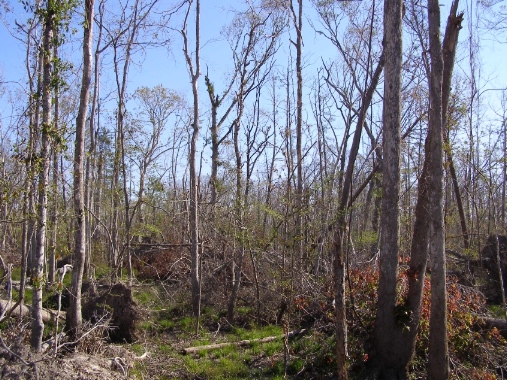
branch with a springing motion. While in the fork, the bird never seemed to engage in any routine activity (such as foraging, drumming, preening, or calling) and appeared to be alarmed and preoccupied with my presence. The photo below shows the view from deep in the woods at the base of the tree in which the bird was perched, looking in the direction where I was sitting in the kayak that morning. By the time the bird appeared in the fork, I had been sitting quietly in the kayak for several minutes at a
distance of 128 meters. Under those conditions, the extremely shy behavior of the bird in the video
would be inconsistent with a Pileated Woodpecker.
Recording of a possible alarm call.
I heard high-pitched calls during two encounters with Ivory-billed Woodpeckers and recorded them
during the second encounter. On February 18, I heard kents coming from an Ivory-billed Woodpecker
behind a fallen tree on the bank. I quietly paddled up to the edge of the bank, but the bird
didn’t detect me and kept calling. Perhaps a minute later, a second Ivory-billed Woodpecker
started calling from the opposite bank. Then it apparently noticed me near the first bird and gave
several harsh scolding calls. The high-pitched calls then started coming from the direction of the
second bird, and the first bird went silent. On February 20, the same calls started coming from the
direction of an Ivory-billed Woodpecker right after it flushed. This audio
recording is from the first two minutes of the video. The high-pitched calls sound similar to the
Blue Jay bell call but don’t match published sonograms of bell calls. In the sonograms of known
and putative kent calls, all of the frequencies appear to turn on and off in synch. None of the bell
calls published in the Auk by Kramer and Thompson in 1979 have this property, but the high-pitched
calls do have this property (even though they sound very different from kents). During both
encounters, the calls started at key moments and came from the direction of an Ivory-billed Woodpecker.
On February 20, the source of the calls tracked an Ivory-billed Woodpecker as it moved through more
than 200 meters of dense habitat. I wouldn’t have obtained any video footage if the calls
hadn’t allowed me to keep track of the movements of the bird. Tanner described a high-pitched
call that is given when an Ivory-billed Woodpecker is disturbed, which is consistent with the
observations. There were sixteen calls during the first two minutes after the camera was turned on.
While drifting downstream in the kayak, I kept the camera aimed at the source of the calls. After the
calls stopped, I backed the kayak into the opposite bank and kept watch. Minutes later, there were
four more calls from deeper in the woods, and then the bird in the video appeared perched in that area.