The 2008 video was obtained about 800 meters from the site where the 2006 video was obtained. From a vantage point 75 feet above the water in
Tree 6, I spotted a large bird approaching from down the bayou just before 9:00 a.m. on March 29, 2008. I initially thought it was a Wood Duck based on the apparent size and the high flight speed. Just before it passed directly below, I saw two white stripes on the back that are diagnostic of Ivory-billed Woodpecker. I also saw white trailing edges on the dorsal surfaces of the wings as the bird continued up the bayou. The video itself documents that I had an ideal vantage point from close range and nearly directly above of the key dorsal field marks. The 2008 video is discussed below and in a lecture and journal articles that may be accessed in the Quick Links section at fishcrow.com.
Since the bird and its reflection from the smooth surface of the bayou are visible, it was possible
to pin down positions of the bird along the flight path. From this information, it was possible to determine the flight speed and that it was
a large bird. The bird has the characteristic wing
motion of a large woodpecker in which the wings are folded closed in the middle of each upstroke. The two
large woodpeckers are the only large candidate species with that type of wing motion. Bret Tobalske, an expert on the flight mechanics of woodpeckers, analyzed the video and concluded that it shows a large
woodpecker on the basis of the wing motion. Only two large woodpeckers have ever been documented north of the
Rio Grande in North America, but the flap rate of the bird in the video is about ten standard deviations above the
mean flap rate of the Pileated Woodpecker. So the bird in the video can only be explained in terms of an
Ivory-billed Woodpecker, and it was identified in the field as such on the basis of definitive field marks that were
clearly seen. The white patches on the dorsal surfaces of the wings are prominent in the video, and there
is also a trace of white up the back and neck that is consistent with dorsal stripes. The high flight speed and narrow wings are consistent with Ivory-billed Woodpecker but not Pileated Woodpecker. Shortly before the bird flew into view an apparent double knock was captured in the video. The footage discussed in the context lecture
documents that it was an overcast morning, the still bayou had a mirror-like surface, and delicate strands of moss hung motionless (except when my movements caused branches to shake). So there is no question that the prominent white patches of the wings correspond to real features (not solar glare) and that there was no tail wind to affect the flight speed.
This movie (17.1 megs) shows the location where the 2008 video was obtained relative to the location where the 2006 video was obtained. Relatively bright green trees occur along the winding bayou. I was aiming the camera at a steep angle most of the time, but it pans upward around 0:06 and gives an impression of the vastness of the Pearl River basin. At 0:22, the location where the 2008 video was obtained is at the lower-left corner of the picture. At 0:30, the picture is centered on a location where I heard loud pounding and then something with loud wingbeats fly across the bayou behind me on 12-26-07. In the same area on 1-17-08, I found a large amount of interesting foraging sign. This is the area that I call the Bermuda Triangle, where I capsized my kayak in 2006, broke my arm in 2007, and had a few run-ins with gators. At 0:37, the camera is aimed down the stretch of bayou where I had several sightings, heard kents, and obtained the 2006 video. At 0:57, the picture is centered on the location where I had my first Ivory-billed Woodpecker sighting two weeks before finding the 2006 hotzone.
Assessment of an expert.
The comments that follow were provided by an expert on the flight mechanics of woodpeckers.

Possible Double Knock.
The camera recorded a possible double knock about 77 seconds before the bird flew into view. Immediately after the double knock, the camera panned in the direction from which the bird appeared.
This audio file compares the double knock from the video with a double knock that was recorded in Florida by Hill et al. (2006). Note that the intervals between knocks are about the same. This movie contains the double knock and shows the context of the encounter. Note that the sky was overcast and that the camera panned down the bayou immediately after the double knock. The resolution is reduced in this movie, which is not intended to show details of the bird.
Expected Flap Style.
Based on historical accounts of a duck-like flight, the flap style of the Ivory-billed Woodpecker w
as thought to be duck like, with the wings remaining extended throughout the flap cycle. Details about the
flap style are absent from most historical accounts of the Ivory-billed Woodpecker, but a description by
Eckleberry (1961) of a “straight ducklike flight in which there seemed to be very little movement
of the inner wing” seems to suggest duck-like flaps. In a painting of woodpeckers in flight by Julie
Zickefoose, who painted the cover of the leading contemporary text on the Ivory-billed Woodpecker
(Jackson 2004), the Pileated Woodpecker is correctly shown folding its wings closed in the
middle of the upstroke, while the Ivory-billed Woodpecker is shown with the wings remaining extended
throughout the flap cycle. Hill et al. (2006) apparently expected the flaps to differ from
those of the Pileated Woodpecker since they reported an Ivory-billed Woodpecker in flight in the
Choctawhatchee River with “stiff wingbeats” (which is synonymous with “duck-like
flaps”) without further comment.
Observed Flap Style.
This movie (half speed) shows part of the cruising flight
as the bird approached the observation tree. This movie (quarter speed) shows
part of the cruising flight reflected off the water after the bird passed the observation tree.
Note that the wings are folded closed during the middle of each upstroke. This is radically different from
the duck-like flaps that were expected. Does this apparent contradiction rule out Ivory-billed Woodpecker?
Or was there a misconception about the flap style? Dalcio Dacol resolved this mystery when he discovered
a historical photo that contains a clue about the flap style that was apparently overlooked for
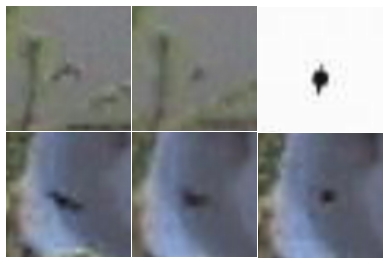
many years. In the images below, the top row shows two consecutive frames from the video in which the
wings are extended and then folded against the body. The other image in the top row is cropped from a
photo obtained by Tanner in 1939 that shows an Ivory-billed Woodpecker in flight with the wings folded
against the body. The bottom row shows the reflection of the bird off the water in three consecutive
frames that provide a different perspective on the folding of the wings against the body. Accounts of a
duck-like flight were apparently based on the duck-like speed and directness of the flight, not the
flap style. The Pileated Woodpecker and the Ivory-billed Woodpecker are the only species native to
Louisiana that have such a flap style and a wingspan greater than 24 inches.
Wingspan.
Since the bird and its reflection off the surface of the bayou are visible, it is possible to determine
the position of the bird by triangulation and use this information to estimate wingspan. Although
straightforward on paper, it was a tedious iterative process to repeatedly climb back up Tree 6 and make
adjustments until the reference object was in the correct position (Amity Bass, Dave Coke, Gretchen Dawson,
Susan Epps, Tommy Tuma, and Wayne Higginbotham assisted in this effort). An advantage of the first part of
the video is that the bird appears nearly head-on as it approaches Tree 6, but the tips of the fully
extended wings are not well resolved in that part of the video. The tips of the fully extended wings are
well resolved in the reflection of the bird off the water just before it passed Tree 6, but the reflected
image corresponds to a position several feet below the surface. An approximate bound on the wingspan was
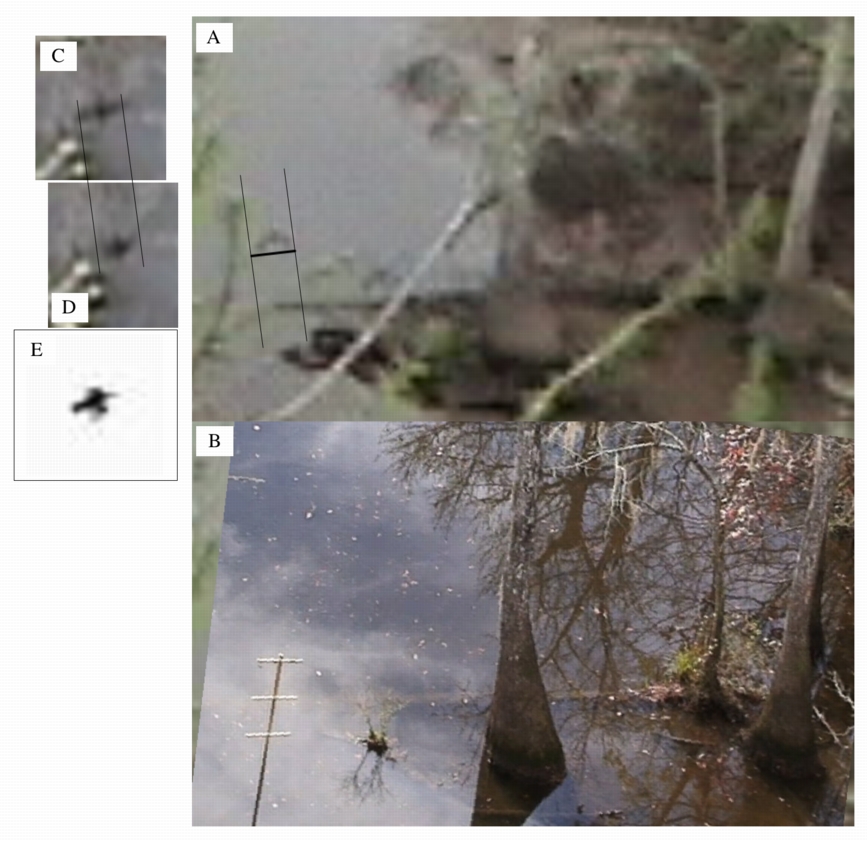
obtained using a combination of images from these parts of the video. In the montage below, the wings are
partially extended in A. The horizontal position of the bird in that image was determined by triangulation,
and a stake with 24-inch crossbars was driven into the ground at that position as shown in B. The top
crossbar, which is located at the position of the bird, was used to scale the black bar that appears
below the bird in A (the reference image was obtained from the same position as the video and was scaled
and rotated using the two large tupelos and other reference objects). The reflected images in C and D were
scaled by assuming that the wings are extended by about the same amount in A and D. From the image in D,
it appears that there are downward and backward components to the bending of the wings. The Tanner photo
of an Ivory-billed Woodpecker in flight in E shows the same effect. There is an unpublished Tanner photo
of an Ivory-billed Woodpecker in flight (of much higher quality than the image in E) that shows swept-back
wings that are strikingly similar to the swept-back wings in D. The backward component of the bending of
the wings would make it difficult to estimate wingspan from A alone. The combination of images suggests
that the wingspan is greater than 24 inches. In principle, an improved estimate could be obtained using
the image in C and a reference object that is scaled to take into account the vertical position of the image.
Flight Speed: Part 1.
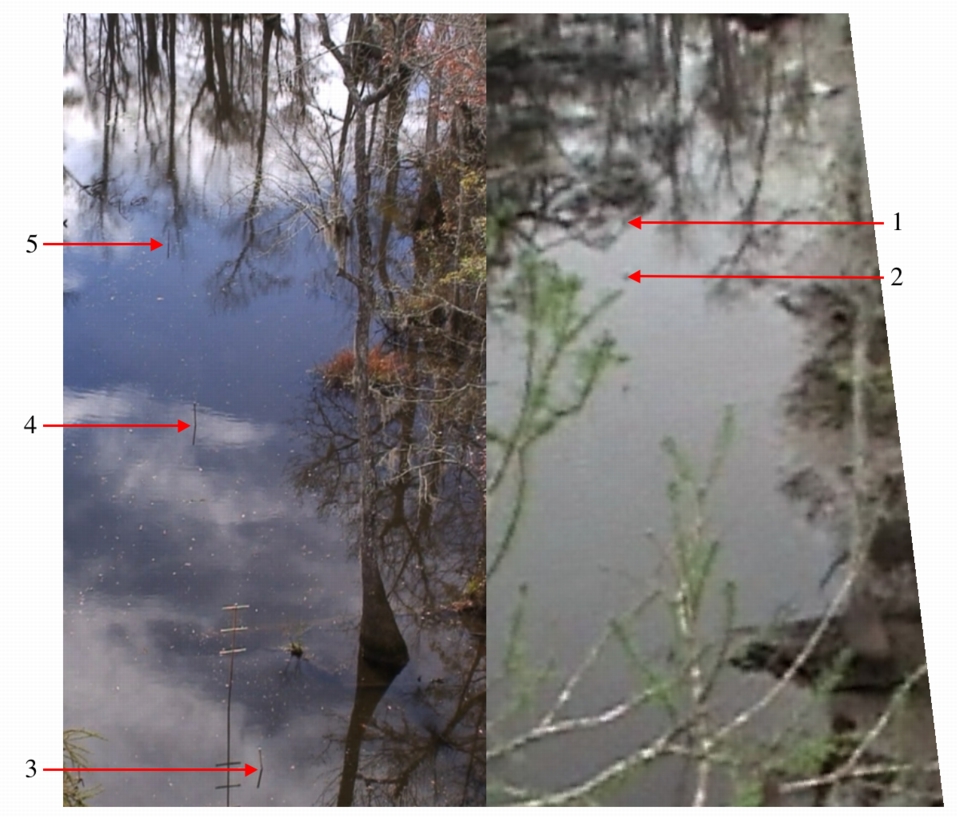
During trips back up the observation tree, stakes were driven into the ground to mark positions of the bird along the flight path. The stakes were placed at the apparent midpoint between the bird and its reflection off the surface, which corresponds to the approximate horizontal position of the bird projected onto the surface of the water. The image from the video below shows the bird when it was nearly directly below. The bird (1) and its reflection (2) are difficult to see in this image but are easy to see when perusing through the video one frame at a time. The position of the stake (3) in the reference image was determined by lining up tree branches (some small branches were lost and the appearance of the moss changed during the time that elapsed between the images).

Flight Speed: Part 2.
The image from the video below shows the bird when it was approaching the observation tree. This image corresponds to 4.38 seconds earlier than the image above that shows the bird below the observation tree. Once again, the bird (1) and its reflection (2) are difficult to see in the image but easy to see when perusing through the video one frame at a time. The proper position for the stake (5) in the reference image was determined by lining up various features, including reflections of the tops of trees off the surface of the water. The small difference in water level only has a small effect. The distance from this stake to the stake below the observation tree is 66.5 meters, which corresponds to 15.2 meters per second. The other stakes were placed at distances corresponding to the minimum (3) and maximum (4) flight speeds of the Pileated Woodpecker, which are 7.5 and 11.6 meters per second according to Tobalske (1996). The bird in the video is much faster than a Pileated Woodpecker.
The Wings.
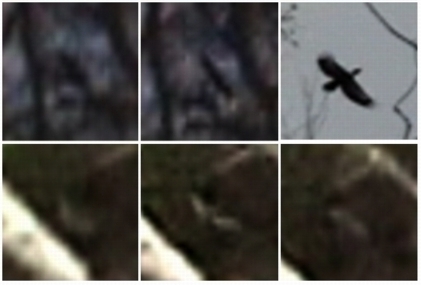
The images below illustrate the wings of the bird in the video. The top row shows the reflection of the bird off the water in two consecutive frames in which the wings appear to have a high aspect ratio (narrow). The other image in the top row illustrates the relatively low aspect ratio (broad) wings of a Pileated Woodpecker. The bottom row shows three consecutive frames in which large white patches are visible on the dorsal surfaces of the wings (dark plumage apparently blends in with the dark mud in the background). The white patches cannot correspond to solar specular reflection since it was an overcast morning.
Wingtip Curves.
Experts in flight mechanics, such as Bret Tobalske, use wingtip curves to analyze wing motion. Toblaske digitized the wingtip elevation and span from the 2008 video that appear in the top set of curves below. The lower set of curves corresponds to a Pileated Woodpecker (Tobalske 1996). Both sets of curves have the same key characteristics. As indicated by the dashed lines, the span has a small value in the middle of the upstroke and a large value in the middle of the downstroke. The shaded areas indicate brief intervals during which the wings were held fixed in the middle of the upstroke. Such pauses are typical in the flaps of woodpeckers, but they had never been reported for the Ivory-billed Woodpecker.
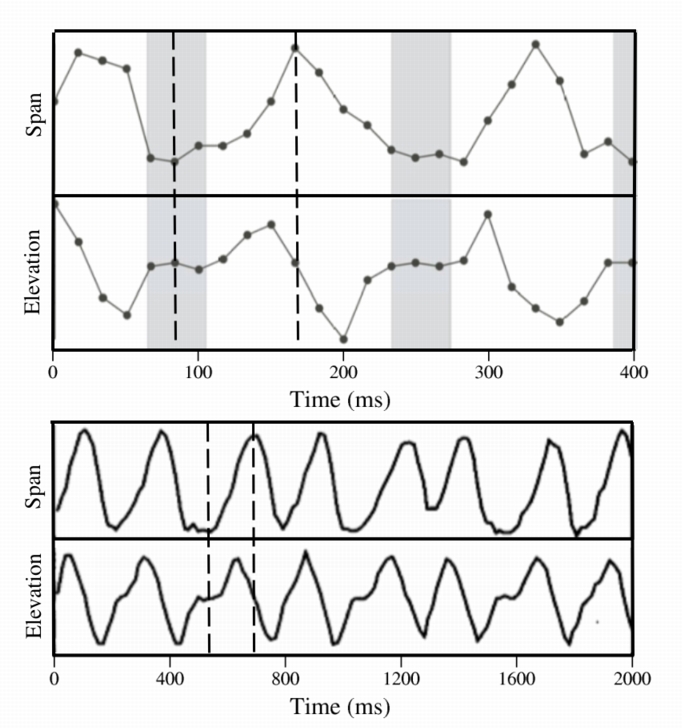
Flap Rate.
Two definitions of flap rate are used for woodpeckers since many species have intermittent flights. The raw flap rate is computed by simply dividing the number of flaps by the elapsed time. The intrinsic flap rate is obtained by subtracting out intervals in which the wings are folded against the body. The raw flap rate varies from 6.6 Hz during the approach (15 flaps in 2.27 s) to 7.5 Hz just beyond the observation tree (4 flaps in 0.533 s). This is much higher than any raw flap rate that has been reported for a Pileated Woodpecker in cruising flight. The mean value of the raw flap rate of the Pileated Woodpecker is 3.7 Hz according to Tobalske (1996), and this value is consistent with
data obtained by Cornell in Arkansas. For the Pileated Woodpecker, the mean intrinsic flap rate is 5.2 Hz with a 0.4 Hz standard deviation (Tobalske 1996). The intrinsic flap rate of the bird in the video is about 10 Hz, which is more than ten standard deviations greater than the 5.2 Hz mean of the Pileated Woodpecker. The high flap rate of the bird in the video is consistent with Ivory-billed Woodpecker in terms of Tanner’s account of a high flap rate and the predictions of flap rate models.
D. R. Eckleberry (1961) in Discovery: Great Moments in the Lives of Outstanding Naturalists, edited by J. K. Terres (Lippincott, New York).
G. E. Hill et al. (2006)
“Evidence suggesting that Ivory-billed Woodpeckers (Campephilus principalis)
exist in Florida,” Avian Conservation and Ecology 1, online.
J. A. Jackson (2004) In Search of the Ivory-billed Woodpecker (Smithsonian, Washington).
B. W. Tobalske (1996) “Scaling of muscle composition, wing morphology, and intermittent flight behavior in woodpeckers,” Auk 113, 151–177.